欢迎来到 [蚂蚁街]
, 进入
2027宁波国际文具展
As reported by Ningbo Fabu, the Ningbo Municipal Bureau of Statistics and the Ningbo Survey Team of the National Bureau of Statistics have published Ningbo’s economic performance from January to August.
From January to August, Ningbo fully implemented the decisions and arrangements of the Party Central Committee and the State Council as well as the work requirements of the Zhejiang Provincial Party Committee and Provincial Government. Upholding the general work tone of pursuing progress while maintaining stability, the city focused on delivering Xi Jinping’s important “4+1” requirements and the provincial Party Committee’s overall “132” work plan. Proactively responding to risks and challenges, Ningbo strove to unlock policy effectiveness and accelerate the shift from old to new growth drivers, sustaining stable economic performance across the city.
From January to August, the added value of industrial enterprises above designated size rose by 8.5% year-on-year. Among this, the added value of private enterprises increased by 11.3%. By sector, nine out of the top ten industries by added value recorded year-on-year growth while one declined; collectively they drove the growth of added value of industrial enterprises above designated size by 7.5 percentage points. The added value of automobile manufacturing and computer, communications and other electronic equipment manufacturing grew by 30.3% and 12.3% respectively, both achieving double-digit expansion. By enterprise scale, added value of large enterprises climbed 12.6%, medium-sized enterprises 2.8%, and small enterprises 7.4%. For emerging industries, manufacturing added value of high-end equipment, high-tech industries and core industries of the digital economy increased by 14.8%, 10.8% and 9.9% respectively, all outpacing the growth of industrial enterprises above designated size.
For January–July, operating revenue of service enterprises above designated size (excluding wholesale, retail, accommodation, catering, finance and real estate development) rose 7.5% year-on-year, 1.1 percentage points higher than the January–June reading. Revenue of science and technology services and high-tech service enterprises increased by 7.9% and 9.1% respectively.
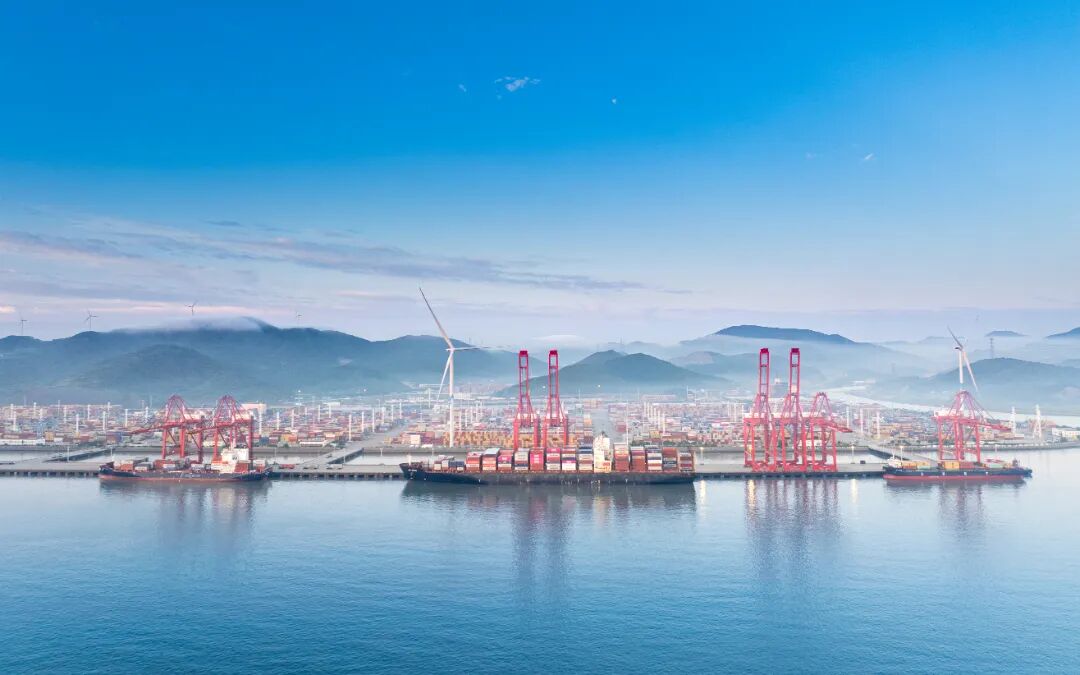
From January to August, cargo throughput of the Ningbo-Zhoushan Port reached 947 million tonnes, down 1.1%. Cargo throughput within the Ningbo port area stood at 464 million tonnes, a drop of 2.7%. Container throughput of Ningbo-Zhoushan Port hit 30.4 million TEUs, up 6.1%, while container throughput in the Ningbo port area reached 26.88 million TEUs, rising 4.7%.
At the end of August, the balance of local and foreign currency deposits of financial institutions in the city stood at RMB 4.31 trillion, and loan balance at RMB 4.84 trillion, up 8.9% and 6.7% respectively.
From January to August, fixed-asset investment across the city fell by 3.9% year-on-year. Excluding real estate development investment, fixed-asset investment grew by 2.2%. By sector, manufacturing investment rose 8.4%, 12.3 percentage points above overall investment growth; infrastructure investment increased 5.7%, of which transportation investment jumped 12.6%. Real estate development investment dropped 19.0%.
Investment in core digital economy industries, equipment manufacturing and high-tech industries increased by 37.5%, 15.7% and 13.9% respectively. The floor space of commercial housing sold reached 4.2 million square metres, down 0.7%.
From January to August, total retail sales of consumer goods reached RMB 375.2 billion, up 3.0% year-on-year. Retail sales of consumer goods by units above designated size totalled RMB 149.4 billion, also rising 3.0%.
Consumption of daily necessities grew steadily: retail sales of beverages, grain, oil and food, and daily commodities by units above designated size increased by 11.9%, 9.6% and 7.3% respectively. Sales of some upgraded consumer goods surged: retail sales of wearable smart devices and smartphones by units above designated size multiplied by 1.5 times and 1.2 times respectively.
Online retail sales by units above designated size via public networks grew by 17.4%, accounting for 42.1% of their total retail sales of consumer goods, 5.0 percentage points higher year-on-year.
From January to August, total foreign trade volume reached RMB 1.04 trillion, a 7.0% year-on-year increase. Exports stood at RMB 714.6 billion (+8.5%), and imports RMB 322.3 billion (+3.8%).
Private enterprises played a pivotal role, with import and export volume of RMB 812.4 billion, up 8.1%. This drove overall foreign trade growth by 6.3 percentage points and made up 78.3% of the city’s total trade volume.
Trade with the EU, the United States and ASEAN rose by 4.1%, 3.7% and 22.0% respectively. Exports of mechanical and electrical products reached RMB 413.1 billion, up 7.8%, representing 57.8% of total exports. Exports of the “new three” products hit RMB 47.3 billion, soaring 114.8%.
From January to August, the urban Consumer Price Index (CPI) rose by 1.3% cumulatively year-on-year. Food prices edged up 0.2%, while non-food prices rose 1.5%.
In August alone, urban CPI increased 0.9% year-on-year, 0.2 percentage points faster than the previous month; month-on-month CPI turned from flat to a 0.1% rise.
From January to August, the Producer Price Index for Industrial Products (PPI) went up 2.3% year-on-year, while the Industrial Purchasing Price Index grew 6.9%. In August, factory-gate prices rose 4.4% year-on-year, 0.4 percentage points higher than July. Purchasing prices climbed 9.7% year-on-year.
On the whole, Ningbo’s economy maintained stable operation from January to August with sustained development resilience. Nevertheless, the external environment remains complex and volatile, some enterprises face difficulties in production and operation, and effective demand remains insufficient. More efforts are needed to consolidate the foundation for steady improvement.
Going forward, we will follow Xi Jinping Thought on Socialism with Chinese Characteristics for a New Era, adhere to the principle of pursuing progress while maintaining stability and improving quality and efficiency. In response to the requirement to “better play a leading and driving role”, we will fully stabilise the industrial fundamentals, expand and upgrade the service sector, unlock consumption potential, and implement a comprehensive strategy to stabilise, expand, adjust and optimise foreign trade, so as to steer the economy toward sustained, high-quality and improved development.

 14
14